By the time the auditor reaches out, they’ll want to review your historical data. But just because you might have compliance gaps doesn't mean your final bill is locked in.
In this article, we explain why your past and current compliance affects your audit outcome, what a lookback period is, where the exposure comes from, and how to achieve a no-change letter in an audit when an auditor assesses $0 due.
How Does Your Compliance Affect an Audit Bill?
When you receive an audit notice, it means the state is initiating a review of your historical records over a set period to check for unpaid tax liabilities.
If you made a compliance mistake in the past, like crossing a nexus threshold and failing to register or collect sales tax, a liability already exists. The auditor’s job is to find these mistakes and calculate a bill.
They do that by reviewing your historical records, like general ledgers, federal tax returns, and past transaction data, to spot any errors or gaps.
If they can’t find any errors, then you won’t be given a tax bill. However, if they find an error, the bill can be inflated beyond just the back taxes that you owe.
Why Expert Support Is Important
If you suspect you have compliance gaps, it’s in your best interest to contact an expert. The sooner you act, the more options you have to clean up historical exposure well before an auditor ever discovers it.
Depending on the size of the liability, there are a few strategies you can use. If the exposure is a lot, then a Voluntary Disclosure Agreement (VDA) is often the best route to take. You’ll still have to pay the back taxes and interest, but stepping forward by choice will often wipe out the penalties and limit how many years the state can look back.
Once an audit notice arrives, certain options like VDAs are taken off the table. But even then, having an expert in your corner to help lower the final costs and take over the workload is extremely valuable. For example, TaxValet successfully abated 48.9% of all penalties and interest assessed to our clients who had past sales tax liabilities from their pre-TaxValet days.
How Far Back Can a State Sales Tax Audit Go? (The Lookback Period)
Once an audit starts, the auditor reviews your records over a set legal window called a lookback period.
In most states, this is three to four years.
But if a business doesn’t register or file a return in a state where they have nexus, the statute of limitations never starts. The state can legally audit the business back to the exact date they first triggered nexus.
Where Does Sales Tax Audit Exposure Come From?
Sales tax exposure tends to come from honest mistakes. They can happen easily due to how complex sales tax is to manage without expert help.
These are the typical mistakes we see happen:
| Compliance Gap | What Happens | The Impact | How to Stay Compliant |
| Sales Tax Software Errors | Software automatically assigns your products to the incorrect taxability categories. It also doesn’t track use tax or have any QA steps in place to double-check under- or over-collection. |
Because of these gaps, you might fail to collect the right amount of sales tax over hundreds or even thousands of transactions. |
Manually assign every product to state-specific tax codes, track consumer use tax, and run QA tests on your software when you change settings to catch calculation errors. |
| Missing or Incorrect Exemption Certificates | You fail to collect a valid B2B exemption certificate at the time of the transaction, or they’re missing. |
The auditor defaults the transaction to 100% taxable, forcing you to pay the tax directly out of pocket. |
Obtain, verify for state-specific accuracy, and securely retain all B2B exemption certificates prior to releasing any tax-exempt transaction. |
| Failure to Register (Nexus) | You had a legal obligation to collect tax but never registered or filed returns in that state. |
This might mean you never collected sales tax from your customers, meaning any back taxes owed will come out of pocket. |
Aggregate gross revenue and transaction count across all combined sales channels on an ongoing basis and register immediately when a state threshold has been crossed. |
| Unpaid Use Tax | You buy software, equipment, or supplies from vendors who don't charge sales tax, and your team fails to remit the use tax owed. |
When auditors pull your general ledgers and expense reports, they assess back taxes and penalties on all untaxed business purchases. |
Audit internal general ledgers and expense reports regularly for untaxed business purchases and remit the use tax directly to the state. |
| Tax Law Changes | States constantly update tax rates and product taxability rules, but your sales tax settings are not updated at the platform/channel level to reflect them. |
You unknowingly start under-collecting tax from your customers, compounding into a massive liability by the time an auditor reviews your books years later. |
Keep an eye out for changes in state legislation and manually update your platform’s tax rules so that your system is always calculating based on the latest laws. |
The blind spots left by software are why so many people are ditching sales tax tools. In fact, 45 of our current clients switched directly to TaxValet from tools like Avalara, TaxJar, and Numeral.
What to Expect When Preparing for a Sales Tax Audit?
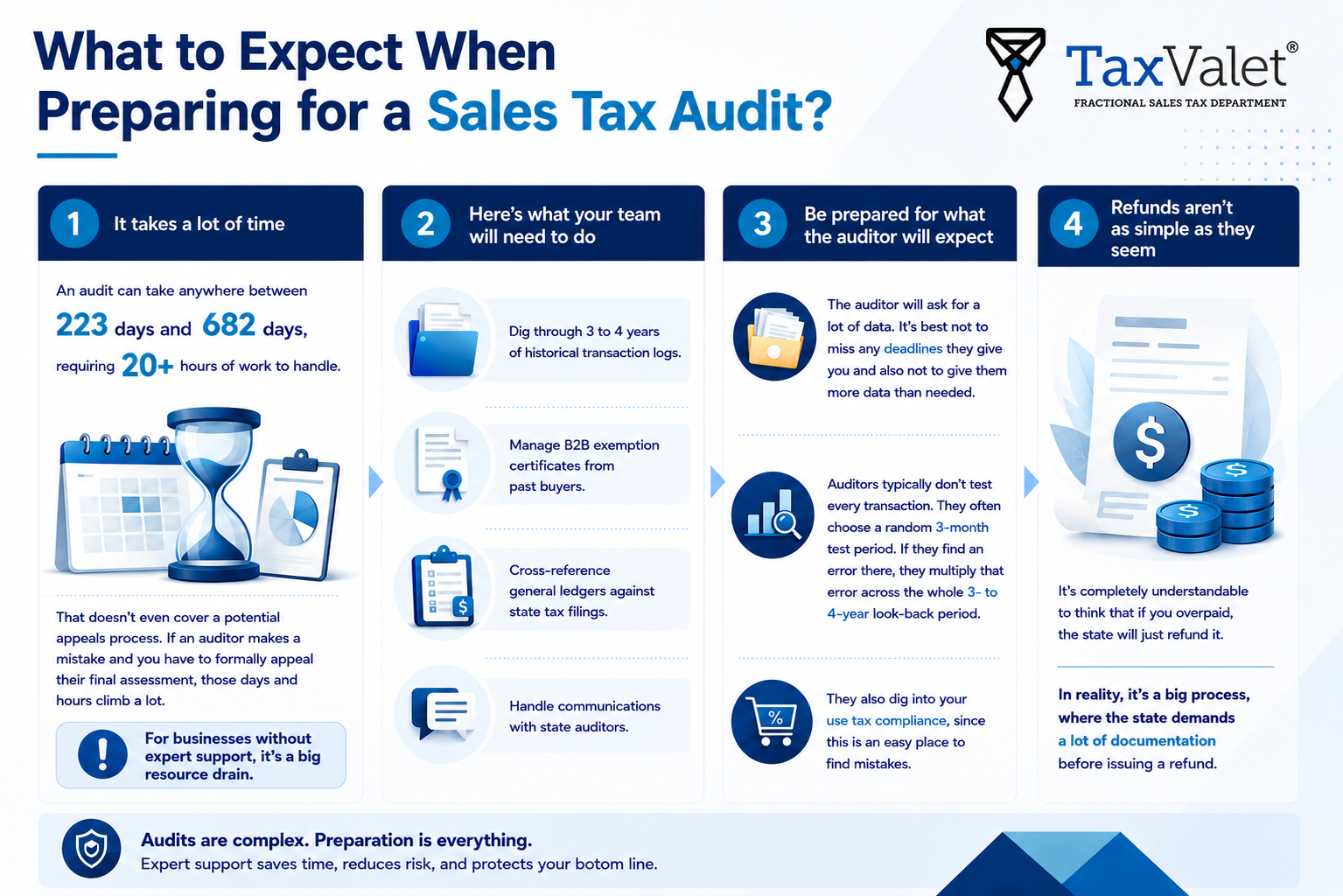
The first thing to expect when an audit starts is that it takes a lot of time. According to our records, an audit can take anywhere between 223 days and 682 days, requiring 20+ hours of work to handle.
That doesn't even cover a potential appeals process. If an auditor makes a mistake and you have to formally appeal their final assessment, those days and hours climb a lot.
For businesses without expert support, it’s a big resource drain. Your team has to:
- Dig through 3 to 4 years of historical transaction logs.
- Manage B2B exemption certificates from past buyers.
- Cross-reference general ledgers against state tax filings.
- Handle communications with state auditors.
Secondly, it’s best to be prepared for what the auditor will expect from you:
- The auditor will ask for a lot of data. It’s best not to miss any deadlines they give you and also not to give them more data than needed.
- Auditors typically don’t test every transaction. They often choose a random 3-month test period. If they find an error there, they multiply that error across the whole 3- to 4-year look-back period.
- They also dig into your use tax compliance, since this is an easy place to find mistakes.
Lastly, it’s completely understandable to think that if you overpaid, the state will just refund it. In reality, it’s a big process, where the state demands a lot of documentation before issuing a refund.
💡Click to view full image
How to Minimize Your Sales Tax Audit Risk?
One of the best things about being fully sales tax compliant is achieving what we call a 'no change' audit. This is when the state auditor reviews your books, finds no errors, and assesses $0 due.
Because we maintain clean historical records and filings and prepare your resale certificates, state auditors who review our clients' books find nothing to penalize.
On top of that, if you ever go through an audit and we mess up, we cover the full cost of the liability caused by that mistake, which to date has been $0.
All of this, in a single, cost-effective, full-service plan that costs a fraction of a single specialist sales tax employee.
FAQs
What triggers a sales tax audit?
The most common triggers are high-risk industries, third-party data mismatches, sudden drops in reported revenue, unregistered nexus, failing to remit use tax, and vendors being audited.
However, you should keep in mind that even if you make zero mistakes or raise zero red flags, you could still end up being selected for an audit. States routinely conduct random audits, which is exactly why your books must be audit-ready every single day.
What are back taxes?
The unpaid taxes that a business failed to collect and remit to the state. Since the state wasn't paid, the business must pay them out of pocket.
What is the penalty for a sales tax audit?
Penalties range from 5% to 50% of the tax due, depending on the state and the violation (late filing, negligence, or civil fraud). The average is often around 10-30%.
What is interest on sales tax?
Interest is a daily/monthly percentage applied to the original unpaid tax from the date it was initially due. It accrues until the tax is fully paid.
What are the requirements for a sales tax audit?
Auditors require you to submit historical transaction data, federal tax returns, general ledgers, sales and use tax returns, point-of-sale data, and valid exemption certificates to prove tax-exempt sales.
How to avoid a sales tax audit?
You can't avoid state scrutiny; audits can happen to anyone. But you can achieve a $0 outcome by proactively monitoring nexus thresholds, accurately mapping products, remitting consumer use tax, maintaining valid exemption certificates, and filing on time.
The best way to do this is to have an expert in your corner, like a fractional sales tax department, to mitigate your risk early.