Use tax is like a backup sales tax. It applies when you buy a taxable item without paying sales tax at the time of purchase, but then use, store, or consume it in your home state.
For example, if you buy a couch from an online vendor in Oregon that doesn't charge sales tax, but use it at your office in Montana, you owe use tax to Montana.
The tricky thing is that most businesses track the sales tax they collect from customers, but they often overlook the tax due on their own purchases. Missing these payments is a common reason for unexpected assessments.
In this guide, you’ll learn about why this is a hidden trap, how it differs from sales tax, how to calculate use tax, the steps to file it correctly, and when it applies.
What’s the Difference Between Sales Tax and Use Tax?
Sales tax is what you collect from customers. Use tax is what you pay out of your own pocket.
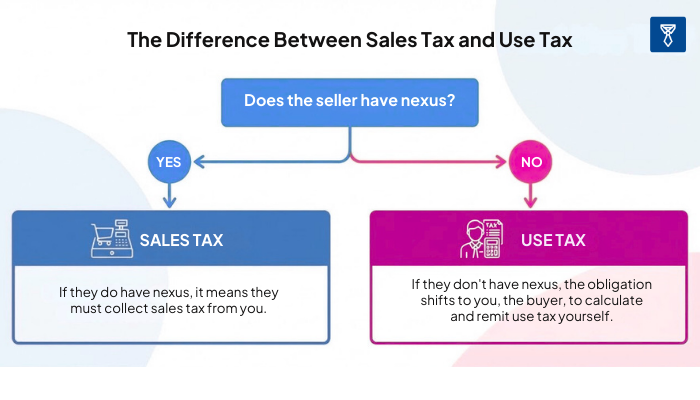
In terms of who pays, the responsibility depends on whether the seller has nexus in your state:
- If they do have nexus, it means they must collect sales tax from you.
- If they don't have nexus, the obligation shifts to you, the buyer, to calculate and remit use tax yourself.
Tip: Check the receipt or invoice to see if sales tax was collected during purchase.
💡Click to view full image
When Does Use Tax Apply?
Use tax applies based on where you use the item, not where you purchase it.
In most cases, you’ll see use tax being owed in these three situations:
1. Out-of-State Purchases
Out-of-state purchases happen when you buy goods from a vendor outside your state that doesn't charge you sales tax.
2. Inventory Withdrawals
Inventory withdrawals occur when you take items originally purchased for resale and use them for your own business operations.
Auditors frequently catch this error by identifying items that were purchased tax-free but never recorded as a sale.
3. Taxable Services
Taxable services refer to intangible purchases like SaaS tools or cleaning crews rather than physical products.
Taxation on these items varies based on which state you operate in. For example, New York, Texas, Washington, Hawaii (and many others) treat SaaS as a taxable service. If you are in NY and buy software from a CA company that doesn't charge you sales tax, you legally owe NY use tax on that subscription.
How to Calculate Use Tax
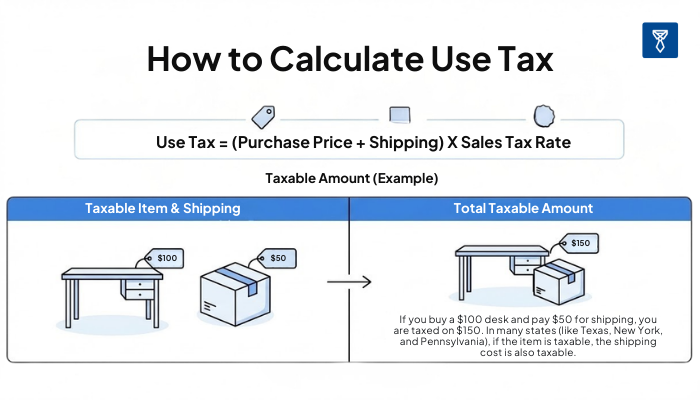
Use Tax = (Purchase Price + Shipping) X Sales Tax Rate
Wait, shipping? Yes. In many states (like Texas, New York, and Pennsylvania), if the item is taxable, the shipping cost is also taxable. If you buy a $100 desk and pay $50 for shipping, you are taxed on $150.
If you already paid sales tax to another state, you don't pay the full amount again. You only pay the difference. This is called ‘Reciprocity.’
- Scenario: You buy a laptop in a state with 4% sales tax.
- Home: You live in a state with 9% sales tax.
- Result: You owe your home state 5% (9% - 4%).
 💡Click to view full image
Note: If you paid more than your home state's rate (e.g., bought in 9%, live in 4%), you generally don't get a refund. You just owe $0.
How to File and Pay Use Tax
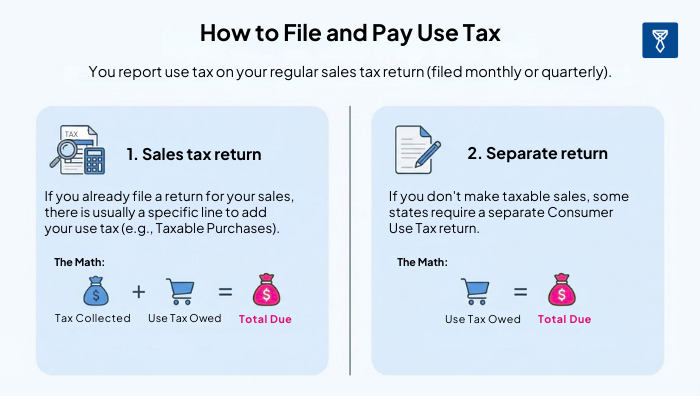
You report use tax on your regular sales tax return (filed monthly or quarterly).
There are generally two ways to report use tax:
- Sales tax return: If you already file a return for your sales, there's usually a specific line to add your use tax (e.g., Taxable Purchases).
- The Math: Total Due = (Tax Collected from Customers) + (Use Tax You Owe).
- Separate return: If you don't make taxable sales, some states require a separate Consumer Use Tax return.
- The Math: Total Due = (Use Tax You Owe).
 💡Click to view full image
Why Auditors Obsess Over Use Tax
Auditors target businesses for use tax because it’s easy for them to identify, and often, the number one oversight for even the most diligent businesses.
To find it, they go straight for your fixed assets. All they have to do is pull your list of new purchases, like computers, furniture, and machinery, and ask to see the invoices. As soon as they spot an invoice from an out-of-state vendor with $0 tax, they can flag it for assessment. This is a common struggle because most businesses simply pay the bill and move on, without realizing the vendor failed to charge tax.
Which States Require Use Tax?
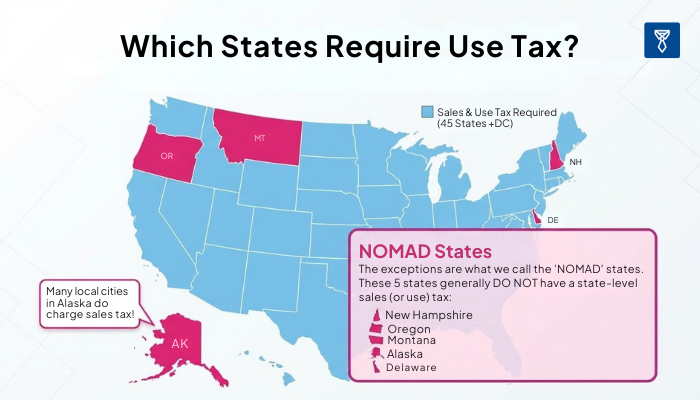
If a state has sales tax, it also has use tax. You can't have one without the other, or everyone would just buy everything across the border.
Thus, use tax applies in 45 states + DC. The exceptions are what we call the ‘NOMAD’ states. These 5 states generally DO NOT have a state-level sales (or use) tax:
- New Hampshire
- Oregon
- Montana
- Alaska (Many local cities in Alaska do charge sales tax!)
- Delaware
If you live outside of these 5 states, use tax technically applies.
 💡 Click to view full image
Let TaxValet Handle Your Sales Tax and Use Tax Compliance
Use tax compliance demands human expertise. TaxValet provides exactly that.
Our team serves as your dedicated Fractional Sales Tax Department®. We manually review your purchase journals, catch potential liabilities, and manage your exemption certificates for you.
With TaxValet as your partner, you can focus entirely on running your business, and not on trying to dissect the differences between sales tax and use tax.
Ready to feel relief from managing your sales tax and use tax? Book a no-obligation call to learn more.
FAQs
1. What is an example of US use tax?
Say you live in California (the sales tax rate is roughly 9%). You drive north to Oregon (the sales tax rate is 0%) and buy a $2,000 laptop. You drive back home to California to use it. Since you ‘imported’ that laptop for use in California, you owe California 9% use tax ($180) on your next tax return.
2. Who pays use tax?
In practice, everyone pays use tax. As an individual, if you buy clothes, furniture, or electronics online and the seller doesn't charge tax, you are the one who owes it. As a business, if a company buys equipment, supplies, or inventory tax-free and then uses it for its own operations, the business owes use tax.
3. What is subject to use tax?
Generally, tangible personal property. For example, furniture, cars, computers, office supplies, appliances, and raw materials. Some states now include services (like data processing or landscaping) and digital goods (like software/SaaS, eBooks, and streaming services). If your state taxes the sale of it, they tax the use of it.
4. What is a local use tax?
This is the ‘hidden’ layer of sales tax. Most sales tax rates are a ‘stack’ of state + local taxes. Use tax works the same way. For example, if you live in a specific city, your use tax rate might look like this: State Tax: 6.0% + County Tax: 1.0% + City Tax: 1.5% = Total: 8.5%