Due to how sales tax software is marketed, many who buy it assume they’re getting the best compliance for their buck.
However, when you add in the hidden cost, it quickly becomes one of the most expensive and labor-intensive solutions.
This article will explain the hidden manual work your software doesn't cover, how setup mistakes can lead to audits, the payroll hours lost managing the tool, and why a fully managed service is cheaper and better.
What Your Monthly Software Subscription Actually Leaves Out?
A lot of sales tax software providers don’t include a human component for setup. Software users are the ones who have to configure it to collect the right amount of sales tax.
If it’s not set up correctly, you could under-, over-, or never even collect the right amount of sales tax for months or years.
When a sales tax software error or mistake occurs, it won’t alert you. Because of that, it’s quite easy for unknown errors to compound month after month.
These are the things your subscription leaves out that cause compliance issues:
| The Compliance Task | The Issue | The Risk | The Fix |
| Tax & Product Mapping |
Software doesn’t inherently know which tax category fits a specific product. Often, the software guesses (incorrectly) at a tax code, and sellers just assume that it might be correct. |
If you map incorrectly or forget to enable tax collection, the system processes transactions but collects the wrong amount of tax across many transactions.
|
You have to manually map each product to the correct tax code and make sure tax collection is turned on.
|
| Multi-Channel Nexus Tracking |
Software only tracks economic nexus within its own platform. For example, a platform like Shopify only sees Shopify sales. It doesn't know if you have an Amazon store or if you run wholesale through QuickBooks. |
The software will underestimate your progress towards exceeding the nexus threshold, causing you to not register and collect tax at the right time.
|
You have to combine data from all your revenue streams to calculate your true sales revenue and transaction counts for each state.
|
| Exemption Certificate Verification | Software can’t read an exemption certificate to verify if it's valid. For example, if a clothing business tries to submit a manufacturing exemption certificate, software will just accept it. |
If your certificates are not valid, then the exempt sales are 100% taxable.
|
You must personally evaluate if a certificate is legally valid for that specific transaction before accepting it.
|
| Tax Testing & QA |
Software doesn't test if it’s working properly. |
If you accidentally configure your software for Alabama instead of California, it will apply the wrong rule. |
It’s best to test the system to check if your configurations are actually working in the real world. |
As David Augustine, Co-founder and CEO of Stealth Fitness, notes in a recent case study:
“You're still left at the mercy of the software, and you have to figure it out for yourself how to plug it in which states.”
How Do Sales Tax Software Mistakes Impact a Sales Tax Audit?
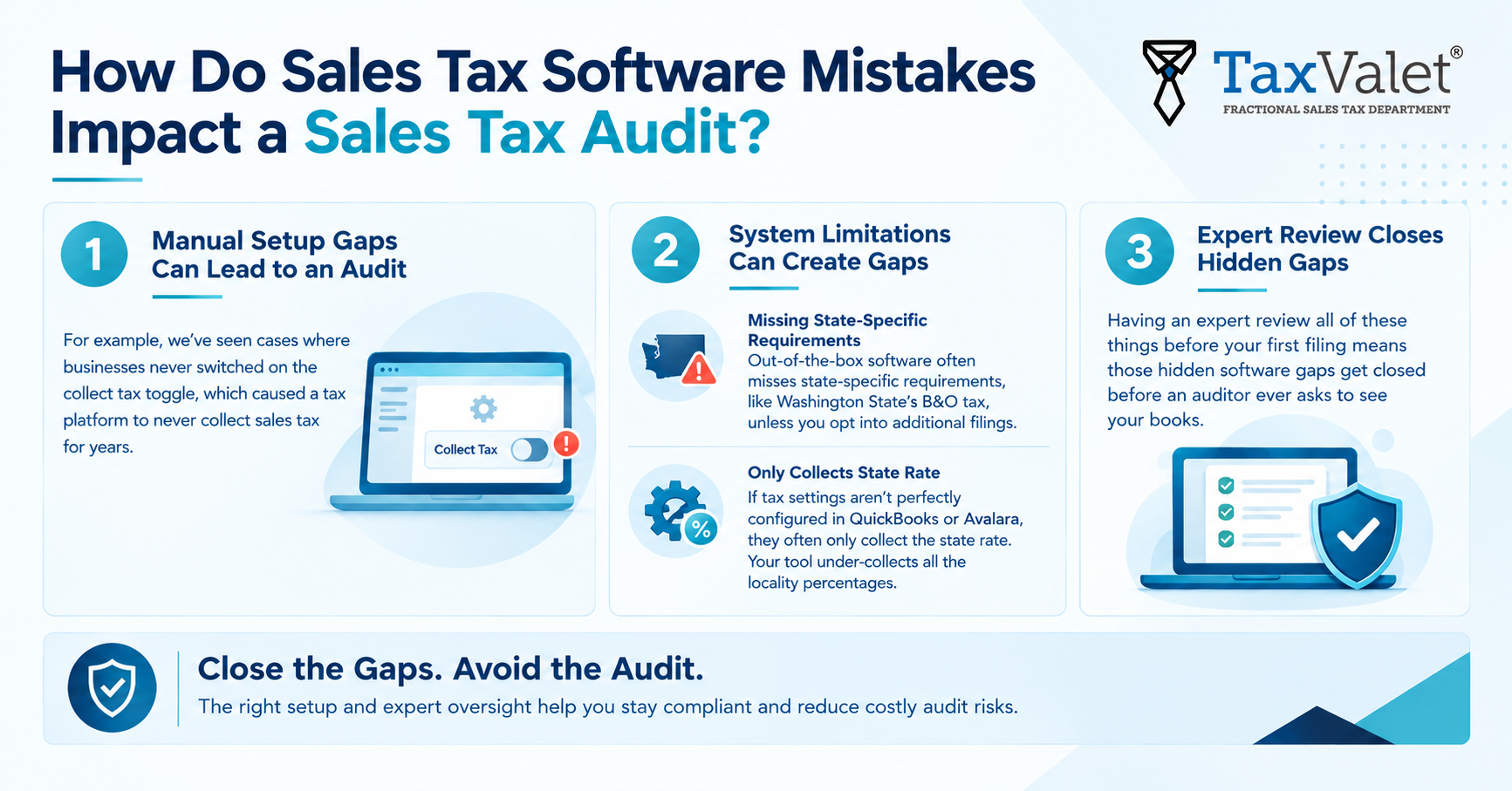
The big issue is that these manual setup gaps can lead to an audit. For example, we’ve seen cases where businesses never switched on the collect tax toggle, which caused a tax platform to never collect sales tax for years.
Aside from the manual setup gaps, there are a few system limitations we tend to find during onboarding new clients that can lead to costly audit outcomes:
- Out-of-the-box software often misses state-specific requirements, like Washington State's B&O tax, unless you explicitly opt into additional filings. Users assume they are 100% compliant, only to get hit with a surprise audit notice and years of unpaid B&O taxes.
- If tax settings aren't perfectly configured in software like QuickBooks or Avalara, they often only collect the state rate. Your tool under-collects all the locality percentages, which can easily become a big liability.
💡Click to view full image
How Much Time Does Managing Sales Tax Software Take?
The other side of the coin is the amount of time sales tax software requires to set up, manage, and fix.
Routine tasks that software ignores, like configuring state permits, applying product exemptions, and testing tax settings, take our team up to 4.5 hours per update.
As you can see, when you rely on software, your team assumes the role of a sales tax administrator. This means, instead of working on dozens of higher-value priorities, your highly paid finance staff are busy with the wrong work.
When platform bugs occur (like a marketplace incorrectly charging tax on tax-exempt items), software won't fight the channel to fix it. Your internal team has to spend months trying to advocate for the fix, which is a waste of your business resources.
If an internal software configuration error slips through and triggers a state audit, the time drain multiplies. Based on our internal data, defending a routine audit takes an average of 20+ hours of dedicated sales tax audit expertise. For an internal finance team with no sales tax expertise, that number is often much higher.
The Cost of Sales Tax Software vs. TaxValet
When you review DIY sales tax software purely on its monthly subscription price, it looks like a bargain.
However, when you factor in the hidden costs, things like the months of internal payroll used doing the manual legwork and the cost of back taxes, penalties, and interest, the overall cost is much higher.
With TaxValet, you get an expert team to handle the entire compliance lifecycle at a fraction of the cost of a single $100,000/year in-house tax specialist. And often cheaper than software once you consider the hidden costs of sales tax software.
Because we’re truly end-to-end, your team spends no time (other than checking monthly filing emails) on sales tax admin. They can do what they’re paid to do.
And because we keep you fully compliant, if an audit happens, you won’t have to face back taxes, penalties, or interest. Plus, if an error on our end ever leads to a liability discovered during an audit, we fully cover the costs, which to date has been $0.
As David mentioned: “If you're thinking about using a software package and just running it through TaxJar, it's just… expensive," David explains. "It's not a cheaper deal to go use TaxJar... By filing with TaxValet, you're getting competitive pricing and you're getting it with real people.”
Are you ready for a truly cost-effective and trustworthy solution to sales tax?
FAQs
What are the most common hidden costs of sales tax software?
The most common hidden costs of sales tax software include internal labor for manual configuration, untracked multi-channel nexus, uncollected local taxes, audit defense fees, and out-of-pocket penalties from compounding software errors.
What is product mapping, and why does it create hidden costs?
Product mapping is the process of clearly defining what you sell so that your tax software can apply the correct taxability matrices. This helps decide how, when, and where to collect tax for each area. Because tax software uses set internal codes, picking one that doesn't match a state's legal definition can lead to mistakes. During an audit, states enforce their own definitions strictly, which can turn small mapping errors into serious financial problems across thousands of transactions.
How does multi-channel selling lead to higher sales tax software costs?
Multi-channel selling inflates software costs through per-channel integration fees, siloed data traps, and the manual labor required to reconcile that data. Standalone software rarely tracks your business holistically. For example, if a Shopify-only integration misses your Amazon revenue, the software will falsely tell you that you haven't crossed a state's nexus threshold, leaving your business exposed to years of back taxes once the state discovers your true footprint.
Who is legally liable if sales tax software makes a calculation error?
The business owner is 100% legally liable for all sales tax calculation errors. Sales tax software terms of service explicitly state that they aren’t liable for under-collected tax, penalties, or interest resulting from software configuration mistakes.
What are sales tax software overage fees and how do they work?
Sales tax software overage fees are automatic charges assessed when your business exceeds its tiered transaction or order limits. They are typically billed per extra transaction or by moving your account into a higher, more expensive subscription tier. During peak sales months or holiday rushes, exceeding those limits triggers unexpected overage charges, making annual software costs unpredictable and difficult to budget.
Why do marketplace transactions create hidden compliance risks?
Selling on your website and online marketplaces can lead to hidden compliance issues and expensive tax mistakes. Marketplaces collect and pay sales tax for you, but automated tax software often doesn’t account for these marketplace sales when you file state taxes. If you don’t remove these sales from your tax filings, you might end up paying sales tax again on orders where tax was already paid. This can lead to double taxation, incorrect reporting of economic nexus thresholds, and inaccurate tax returns.