For most companies, sales tax non-compliance is never intentional. It’s incredibly easy to make honest mistakes, especially with something as complex as multistate sales tax.
While unintentional, these mistakes can become costly to fix and manage. For instance, since 2021, we have guided 38 clients through state audits and managed $458,492 in historical exposure from their pre-TaxValet days.
To help you get a better picture of the costs, this article will discuss the basic costs of a sales tax audit, the factors that impact an assessment, and the cost of preventative protection.
The costs of a sales tax audit can be grouped into two categories:
If we assume a simple audit, the core sales tax audit costs are predictable.
| Cost Type | What It Is | Range / Rate | Example |
| Back Taxes |
Unpaid sales or use tax you failed to collect/remit.
|
100% of the uncollected tax.
|
Accidentally missing $100k in sales tax and $20k in software use tax results in $120,000 that often needs to be paid out of pocket. |
| Interest Owed | Accrued interest on back taxes. Auditors calculate this over a legal lookback period (typically 36 to 48 months). |
3% to 12% annually. |
A 6% interest rate in WA applied to a $120k error over a 36-month lookback adds $21,600 to the assessed bill. |
| Penalties |
Late payment / filing fines or statutory negligence penalties stacked directly on top of an unpaid balance. |
2% to 50% late fees 10% to 25% for negligence penalties |
A 29% penalty in WA on a $120k error adds another $34,800.
|
| Total | A $120,000 compliance error can balloon into a $176,400 total liability. | ||
While back taxes generally can’t be reduced, penalties and interest can. For example, through proper audit defense and formal reduction requests, TaxValet successfully reduced 48.9% of all penalties and interest across a recent sample of 38 audited clients who had outstanding tax exposure before joining TaxValet.
Four compliance gaps can severely inflate your final audit assessment:
| Factor | What Happens | The Impact |
| Missing Historical Data | If your business is missing historical data/records for the periods you’re being audited for, the states are allowed to use estimation methods to determine how much tax is owed. What they tend to do then is look at your current revenue and project it backwards. |
In many cases, what you made this year vs. three to four years ago can vary widely, making the overall bill much higher than it might have been.
|
| Invalid Exemption Certificates | If a B2B exemption certificate is missing, expired, or incorrectly filled out, the auditor defaults the transaction to 100% taxable. |
You’re suddenly on the hook to pay the full taxable amount out of pocket for what are typically massive wholesale transactions. |
| Failure to Register (Nexus) | If you had a legal obligation to collect tax but never registered or filed returns, the standard 3-to-4-year statute of limitations never starts. |
The state can legally audit your business all the way back to the very day your nexus began.
|
| Sample Audit Multipliers | Auditors diligently review a 3-month sample of your records. If they find an error, they multiply that error rate across the entire lookback period. |
A tiny $100 recurring monthly error found in the sample instantly turns into a $4,800 liability on your final bill. |
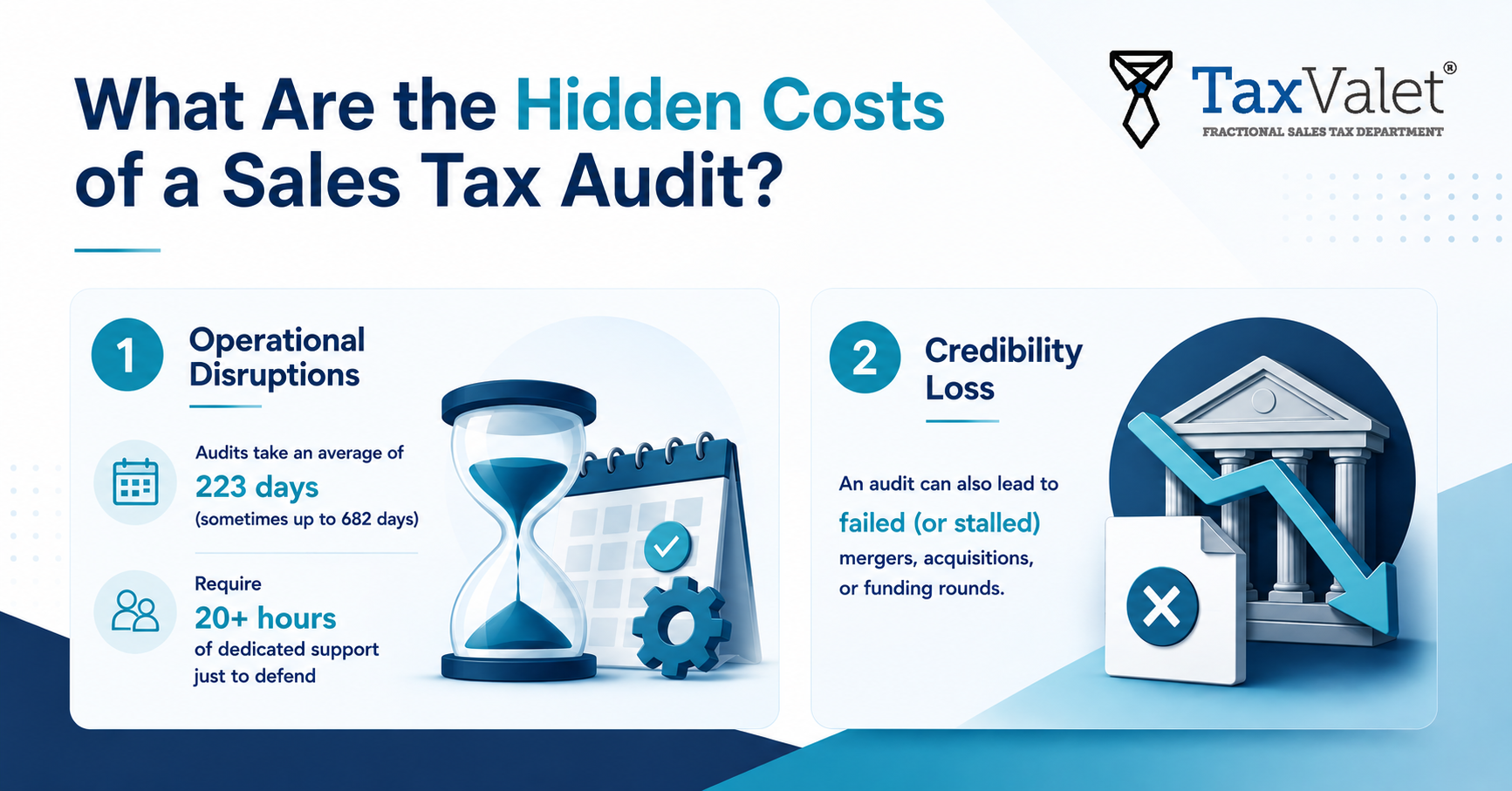
According to our data, audits take an average of 223 days (sometimes up to 682 days) and require 20+ hours of dedicated support just to defend.
Keep in mind that these average times apply to our internal sales tax audit experts, who know how to handle audits efficiently. If you’re handling it with your internal finance team, the time needed could be a lot higher.
An audit can also lead to failed (or stalled) mergers, acquisitions, or funding rounds.
💡Click to view full image
Other than the state’s tax assessment, you have to factor in one final expense: audit defense and support. Successfully managing an audit and saving your team’s time requires specialized experts that can vary wildly in cost.
Here is what sales tax support typically costs:
| Provider / Option | Hourly Rate | Estimated Audit Cost (Based on 20 Hours) | Description |
| TaxValet | Included in full-service subscription ($0 extra) | $0 |
Auditor management & support. We liaise with the auditors on your behalf, gather and submit your documentation, review the final audit results, and guide you through any available appeal options. |
| General CPAs | $250 – $400+ / hr | $8,000+ |
CPAs are rarely state and local tax specialists, which means they might need more time to research. |
| Specialized Sales Tax Consultants | $300 – $500+ / hr | $10,000+ |
Dedicated sales tax audit expertise. But they require high hourly rates and retainers. |
| Tax Attorneys | $450 – $800+ / hr | Varies (Case-by-case) |
Escalation option for formal legal disputes, escalated appeals, or fraud allegations. |
Sales tax audits are complex beasts that demand a lot of time and specialist expertise. It’s not something you should try to handle with only your finance team.
One common mistake we see is businesses sending the state more records and data than what’s needed. This is an easy mistake to make since the state will request a long “laundry list” of documents (like federal tax returns, general ledgers, expense reports, etc.), and you might believe that sending it all over is the right thing to do.
However, when you send more than is actually needed, the auditors end up scrutinizing unrelated business expenses (like out-of-state building maintenance), which can lead to a higher tax bill.
Experts push back. TaxValet knows how to handle a state’s audit “laundry list” and asks auditors to drop irrelevant requests. For example, not providing local expense reports from remote sellers or only providing page one of federal returns to prevent the state from accessing your entire financial history.
It’s also important to remember that state sales tax audits are revenue-generating operations.
For example, the state of California dedicates over 1.9 million audit hours annually and generates $5.40 in revenue for every $1 spent on direct auditing. They have their own Business Analytics Units (BAUs) to analyze external data, such as IRS 1099-K reports and state commerce databases, and intentionally target businesses with potential discrepancies.
In California alone, the CDTFA estimated that its statewide sales tax audit operations from 2026 to 2027 would generate $736,500,000. Other states don’t publicly disclose their sales tax audit reports, but based on California’s data, we can deduce that nationwide, thousands of businesses are affected by audits.
With experts like TaxValet on your side, it’s not intimidating or scary. You get guidance on what’s happening, a team that knows these audits in and out, and audit support every step of the way.
Sales tax audits can happen to any business. When they do, there are two ways you can handle them that will dictate your final cost:
Resolving an audit after the fact means paying out of pocket for back taxes, compounding penalties, and heavy professional defense fees while suffering months of internal business disruption.
A predictable, flat monthly cost for ongoing compliance with TaxValet. We help clean up past exposure when you join us so you’re fully compliant from the start. We also fully manage the audit process for you.
All this is backed up by our 360° Audit Guarantee, which means that if a mistake on our end causes penalties or interest, we’ll cover all the costs.
Back taxes are the missing sales or use taxes that your business failed to collect from customers or remit to the state during prior tax periods. Because you can’t bill customers three years after a transaction occurs, back taxes are often paid directly by your business.
Sales tax interest is a financial charge imposed on past-due taxes from the date they were originally due. Interest rates on late sales tax (or late sales tax collections) in the U.S. range from about 3% per year (0.25% per month) in some states such as Pennsylvania to 12% per year (1% per month) in some states such as Florida and New York.
Auditors apply this rate throughout the state’s legal lookback period, the period of time to review historical records, which is typically 3 to 4 years (36 to 48 months).
Sales tax audit penalties are statutory fines on your unpaid taxes, ranging from 2% to 50% depending on the state. Some states require flat fees for late payments, anywhere from $5 to $100, while others charge fees as a percentage.
Additionally, if an auditor determines that errors were caused by negligence or intent to evade, states can levy a 10% to 25% negligence penalty on top of penalties, back taxes, and interest.
Yes. While back taxes generally can’t be reduced, interest and penalties frequently can through formal negotiation and penalty abatement requests. For example, through proper audit defense, TaxValet successfully reduced 48.9% ($54,213) of all penalties and interest assessed to clients across a recent 38-client sample.
State departments of revenue have dedicated Business Analytics Units (BAUs) that cross-reference external agency data, like 1099-K reporting, and state commerce databases to identify anomalies. Common triggers include sudden drops in reported revenue, high ratios of exempt sales, failure to file returns after crossing economic nexus thresholds, or operating in high-scrutiny industries.