TaxValet | Sales Tax Blog | State laws, E-commerce, SaaS

A Guide to Sales Tax on Advertising Trends | TaxValet

Written by Richard Reynolds | Jun 5, 2026 1:30:00 PM

Digital advertising taxes are a relatively new and rapidly evolving area of sales tax. 

In recent years, the tax base has been expanding more to include digital goods and services as well. Today, more and more states are making laws to tax advertising. 

We don’t want you to feel stuck or lost in this new trend. That’s why we're going to explore the different tax models states are using, the states making moves, the rates, and the impact on businesses.


The Two Distinct Advertising Sales Tax Models

Businesses spend billions on digital advertising, and the states are looking for ways to get a slice of the pie.

Right now, states are taking two entirely different approaches to capture revenue from digital advertising, and both ultimately impact your bottom line.

1. Taxing the Giants

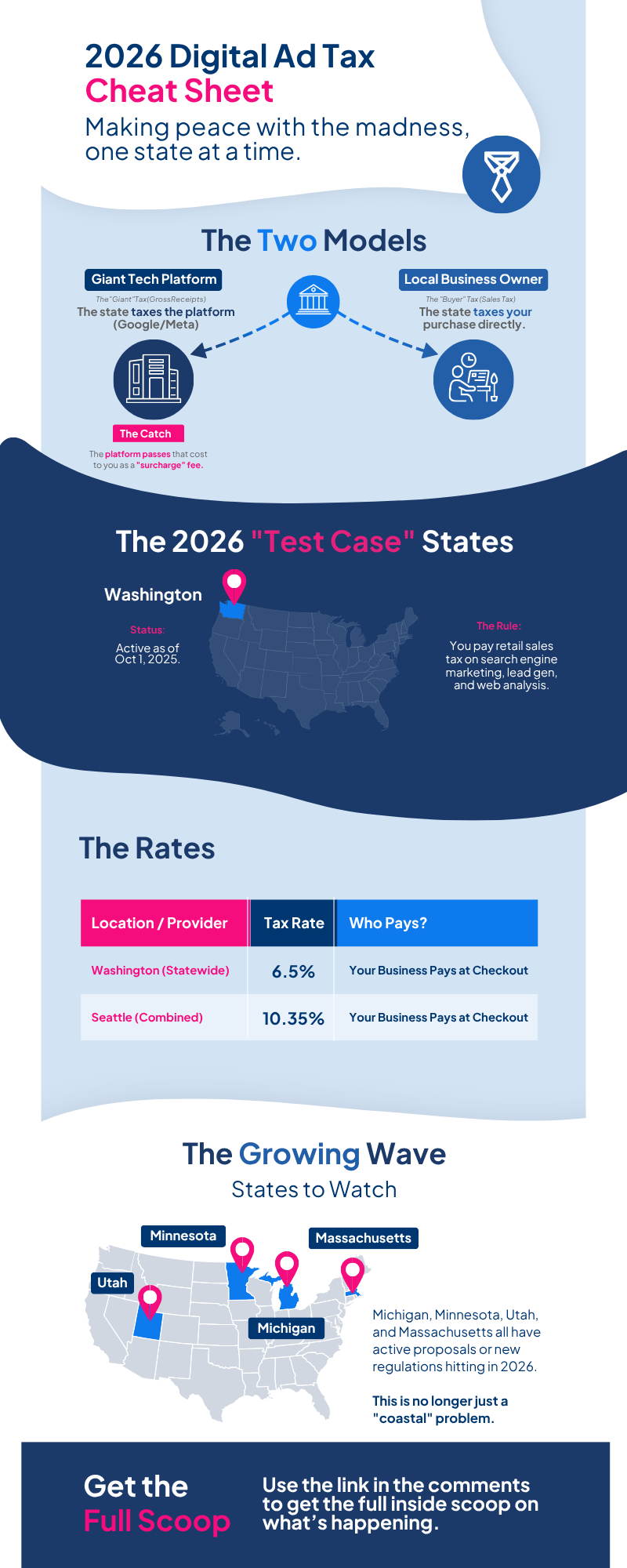
Some states are going straight to the source. They are taxing massive advertising platforms (like Google or Meta) based on the total revenue they make from showing ads in that state.

While your business doesn't pay this tax directly to the state, these platforms often pass the cost down to you as a surcharge on your invoice.


2. Taxing the Buyer

Other states treat digital advertising just like any other taxable service. In this model, the tax is applied directly to the ad purchase itself.

Depending on the state, the seller may charge you sales tax at checkout, or your business may be responsible for reporting and paying the tax directly to the state as a use tax.


U.S. States Taxing Advertising

Let’s look at how these tax models play out in the real world by comparing two states that are actively using them.

Maryland Digital Advertising Tax

Maryland has been the ‘test case’ for the gross receipts tax model, targeting the revenue of massive ad platforms.

While there has been a lot of complex legal back-and-forth, what matters most to your business is a key court ruling from August 2025. The courts decided that these large ad platforms are legally allowed to pass this tax directly on to you.

So, even though you aren't paying the state directly, you will likely see this tax explicitly itemized as a separate fee on your advertising invoices.


Washington Digital Advertising Tax

As of October 1, 2025, Washington state expanded its sales tax reach. Under Senate Bill 5814, digital advertising services (including SEM, lead generation, and website traffic analysis) are now subject to retail sales and use tax.

Washington’s approach is unique because the tax is assessed directly on the business purchasing the ads. If your business is based in Washington and you buy advertising from platforms like Meta or Google, you are the one responsible for the sales tax at the time of purchase.

That makes it a direct operational cost for the local business.


Advertising Tax Proposals in Other States

While Maryland and Washington are already active, several other states are trying to pass their own versions:

💡Click to view full image
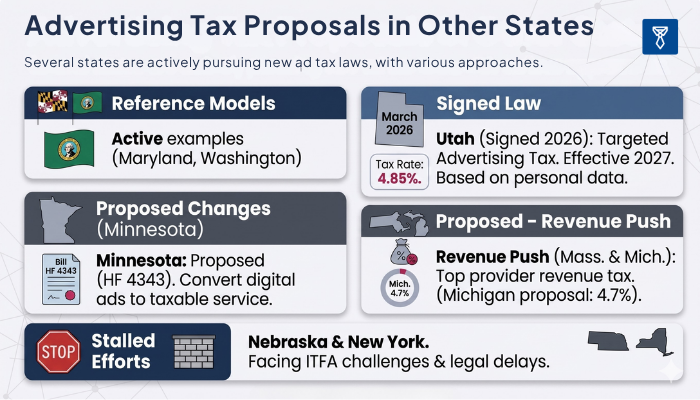
  • Massachusetts & Michigan: These states are pushing hard to tax the total ad revenue of the biggest providers. In Michigan, there is a 2026 proposal for a 4.7% tax specifically to help fund state programs.

  • Utah: Utah just signed a new law in March 2026 called the "Targeted Advertising Tax." Starting in 2027, large platforms will pay a 4.85% tax on ads they show to Utah residents using personal data.

  • Minnesota: A new proposal (HF 4343) was introduced in March 2026. Instead of a ‘Big Tech’ tax, Minnesota is looking to remove the tax-free status of digital ads entirely. This would turn ads into a regular taxable service, similar to the Washington model.

  • Stalled States: Earlier attempts in Nebraska and New York have hit a wall. Federal laws (like the Internet Tax Freedom Act) make it difficult for states to single out internet-only services for extra taxes, leading to legal delays.


Impact on Businesses

The headlines usually focus on tech giants like Google and Meta. But practically speaking, the financial and operational burden falls directly on you.

Whether a platform passes a gross receipts surcharge down to you, or a state requires you to pay direct sales tax on your ad spend, the result is your marketing costs just went up.

It is a frustrating, unexpected line item that can affect your advertising reach.


U.S. State Sales Tax Rates

Here is what the advertising tax rates look like in the two states actively using this new tax:

Washington Ad Sales Tax Rates

  • State rate: 6.5%

  • Local rates: These vary by city. In Seattle, the combined rate can reach 10.55%.

  • What’s taxed: As of October 1, 2025, this covers search engine marketing (SEM), online referrals, and even the planning of your web campaigns.

Maryland Ad Sales Tax Rates

  • The rates: Ranges from 2.5% to 10%.

  • How it works: If you buy ads from a small local site, the tax is low. If you buy from a global giant like Google (which makes over $15 billion), the tax is 10%.

  • The 3% rule: Maryland also has a separate 3% sales tax that started in mid-2025 for IT and software services. However, for now, ‘pure’ digital marketing services (like just running an ad) are excluded from this 3% tax.


Don’t Let Ad Tax Complexity Slow Your Growth

Figuring out if a state is taxing your ad platform’s gross receipts or directly taxing your search engine marketing spend is a big operational burden. You and your team shouldn't be spending time deciphering a maze of constantly changing digital ad tax laws just to stay compliant.

Another software solution also just shifts the administrative load back onto your internal team because ‘automation’ still needs an expert steering the ship. 

As your Fractional Sales Tax Department, TaxValet steps in to handle the entire lifecycle so you can: 

  • Regain operational bandwidth: You and your team get your time back. We manage the entire sales tax process end-to-end, completely removing the administrative load.

  • Eliminate risk: Your enterprise stays audit-ready. We meticulously track these evolving regulations to mitigate your audit risk.

  • Lock-in accountability: Gain complete confidence through expert human judgment. Our dedicated experts take responsibility for the outcomes. 

Book your no-obligation discovery call.