Compared to the challenges of 2025, sales tax in 2026 was a lot calmer for ecommerce businesses.
Sure, there were a few tricky changes, but there were also many big and small wins.
This sales tax review explores the major national trends, state highlights, important legal stories, and what you can do to prepare for 2027.
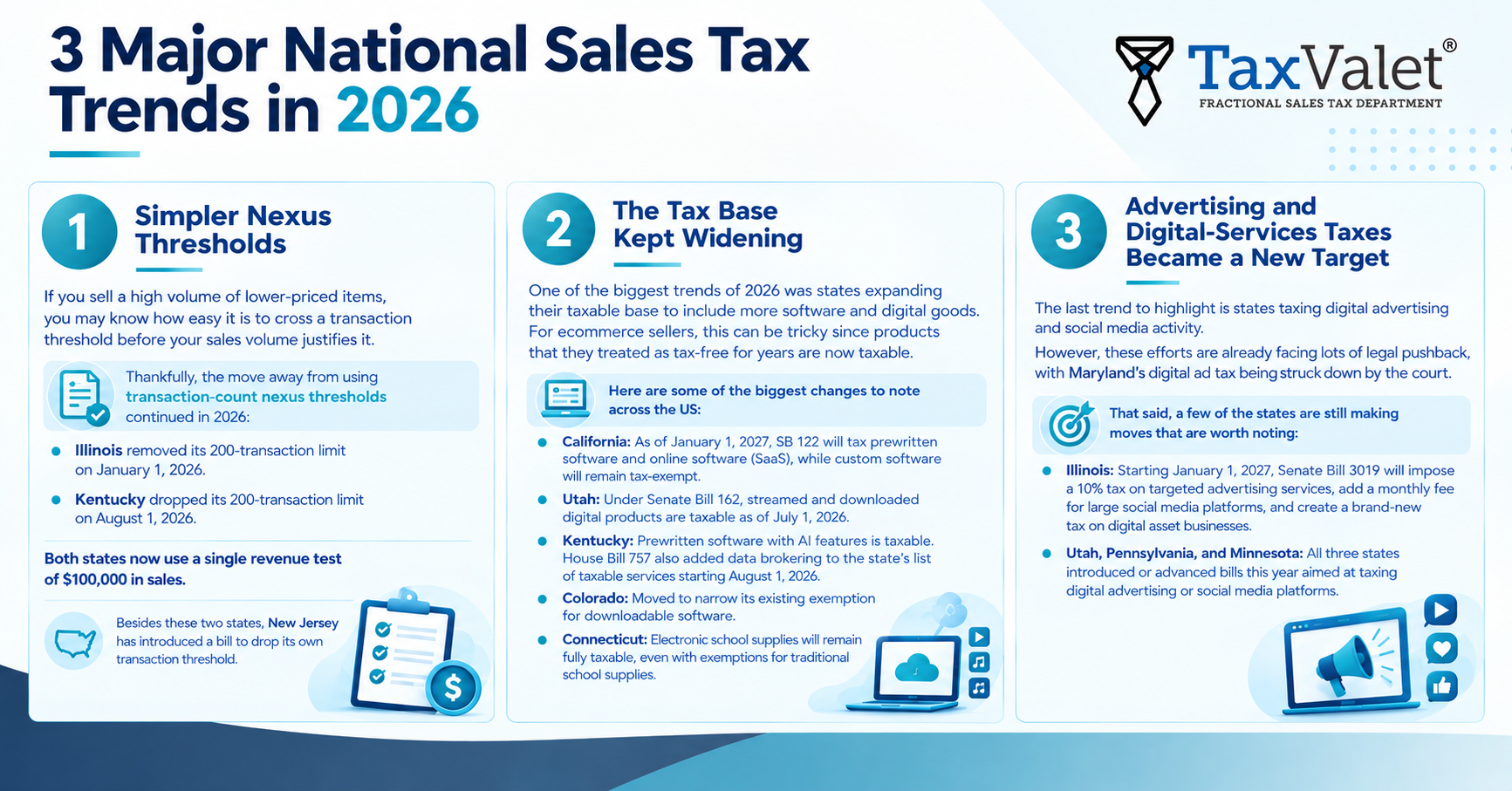
Across the country, these are the top three sales tax trends for 2026.
If you sell a high volume of lower-priced items, you may know how easy it is to cross a transaction threshold before your sales volume justifies it.
Thankfully, the move away from using transaction-count nexus thresholds continued in 2026:
Both states now use a single revenue test of $100,000 in sales.
Besides these two states, New Jersey has introduced a bill to drop its own transaction threshold.
One of the biggest trends of 2026 was states expanding their taxable base to include more software and digital goods. For ecommerce sellers, this can be tricky since products that they treated as tax-free for years are now taxable.
Here are some of the biggest changes to note across the US:
The last trend to highlight is states taxing digital advertising and social media activity.
However, these efforts are already facing lots of legal pushback, with Maryland’s digital ad tax being struck down by the court (more on this in the Legal Spotlight section).
That said, a few of the states are still making moves that are worth noting:
💡 Click to view full image
While tax trends shifted nationwide, a handful of states stood out for major rule changes this year.
Illinois was easily one of the busiest states in 2026:
| The Change | Effective | What It Means |
| Simpler nexus rules & automatic account updates | Jan 1, 2026 |
As noted earlier, Illinois officially dropped the 200-transaction threshold. If you triggered nexus under the old 200-transaction rule but didn't hit $100,000 in sales, your account was changed to “voluntary use tax” status, and notices were sent to explain your status. |
| Local grocery taxes | Jan 1, 2026 |
Under Public Act 103-0781, the 1% state grocery tax was eliminated, but it gave local cities the green light to set up their own 1% tax instead. |
| Chicago lease tax | Jan 1, 2026 |
Chicago bumped its Personal Property Lease Transaction Tax from 11% to 15%, raising the tax bill for cloud software and digital services used in the city. |
| Targeted ad tax | Jan 1, 2027 |
As noted above, effective January 1, 2027, there will be a 10% digital ad revenue tax and fees for major social media platforms. |
| Tax amnesty window | Aug 1 – Oct 31, 2026 |
Illinois held a Remote Retailer Amnesty Program from August 1 to October 31, 2026. Out-of-state sellers could pay unpaid taxes from January 1, 2021, to June 30, 2026, at a flat rate, with no penalties or interest. |
Beyond Illinois (detailed above), states rolled out an unusually high number of tax amnesty programs this year. These give remote sellers a rare chance to step forward, pay past-due taxes, and wipe out penalties and interest.
These are all the amnesty windows that apply to ecommerce businesses:
| State | Amnesty Window | What It Offered |
| Indiana | Jul 15 – Sep 9, 2026 |
Covered unpaid taxes from before 2024 and waived penalties, interest, and collection fees for eligible businesses. |
| New York | Sep 1 – Dec 31, 2026 |
The PAID program waived 100% of penalties and cut accrued interest in half for eligible past-due sales tax bills paid in full. |
| Rhode Island | Dec 3, 2026 – Feb 15, 2027 |
An end-of-year window to wipe out penalties and reduce interest by 25% for taxes owed through the end of 2025. |
A few big moves have happened in court this year that affect ecommerce businesses.
On August 14, 2026, the Maryland Tax Court struck down the state’s digital advertising tax and ordered refunds for the collected money with interest.
The court identified two massive constitutional flaws:
The comptroller has appealed the court's ruling, so this isn't the final decision. For now, it raises doubts about advertising taxes in other states.
Last year's review flagged the tariff case as a big one to watch.
On February 20, 2026, the U.S. Supreme Court ruled in the case of Learning Resources v. Trump that the International Emergency Economic Powers Act (IEEPA) doesn’t permit the president to impose tariffs.
This ruling struck down the 2025 Liberation Day tariffs.
However, the Trump administration quickly pivoted to replace the struck-down tariffs under a different law (Section 122 of the Trade Act of 1974). So while the legal reasons have changed, the cost pressure on your supply chain remains largely the same.
As with almost every year in sales tax, how this year's changes truly affect you depends on what you sell and how you operate.
| If your business is... | …it means |
| Software & digital products | You’re affected by the taxable base expansions to capture SaaS, downloaded goods, and AI tools. |
| Reliant on digital ad spend | There’s a new tax category to keep an eye on. States are testing taxes on digital advertising and social media, though Maryland’s court ruling shows these proposals face steep legal hurdles. |
| High-volume, lower-priced items | You gained helpful breathing room. With Illinois and Kentucky dropping their transaction thresholds, you can build order volume in those states without triggering early tax registration requirements. |
| Everyday ecommerce | With broader product taxability, new threshold rules, and local rate changes, you’re left doing a lot more sales tax admin. |
To be ready for 2027, you can work on these 6 things:
| What to do | How to do it |
| Check state amnesty eligibility | If you owe back taxes in New York or Rhode Island, compare their amnesty rates and lookback periods with a standard Voluntary Disclosure Agreement (VDA) to find the best option. Make sure to apply before these remaining windows close. |
| Re-map software and digital products | Check your product catalog in your tax software before California's new SaaS tax starts on January 1, 2027. Make sure to update your product tax codes and billing contracts so that taxes are calculated correctly during checkout. |
| Review nexus status quarterly | Run sales reports quarterly instead of once a year. With thresholds changing more often, an annual check is no longer enough to catch changes in time. Also check that your tax software turned off the old 200-transaction rules for Illinois and Kentucky. |
| Track use tax on purchases | Check your own software subscriptions and vendor bills. If a vendor didn't charge you sales tax on a taxable purchase, report and pay consumer use tax on your own tax return. |
| Keep audit-ready records | Collect full street addresses (not just ZIP codes) for every order, verify resale certificates from wholesale buyers, and keep all sales and purchase records for 3 to 5 years. |
| Use address-level tax rates | Switch from ZIP-code rates to exact street-address lookup in your tax software so you don't miscalculate rates across overlapping local tax districts. |
Looking ahead to 2027, expect states to double down on the changes they started this year.
Here are the four biggest trends to keep on your radar:
With so many businesses prioritizing cost optimization, dealing with sales tax right now can be a big hurdle for teams working toward that goal.
Instead, you can get a dedicated Fractional Sales Tax Department that manages your sales tax end-to-end with TaxValet. Plus, you get this for a fraction of the cost of one internal sales tax specialist.
Ready to get rid of this hurdle once and for all?